A country risk index is a structured way of comparing countries against a defined set of risks—but different indices often measure very different things. One may focus on sovereign creditworthiness, another on political stability, another on business conditions, and another on internal conflict.
This creates a common source of confusion. A country can rank as low risk on one index and high risk on another without either result being wrong, because the models are answering different questions.
This guide explains the main types of country risk index, how political risk indices differ from conflict-risk indicators, what a country ranking can and cannot tell you, and where ConflictMeter fits.
What is a country risk index?
A country risk index combines selected indicators to compare countries according to a defined concept of risk. The index may produce a numerical score, rank, category or rating.
The most important question is therefore not “what is this country’s risk score?” but “risk of what?”
Different users care about different outcomes:
- a lender may care about sovereign repayment capacity;
- an investor may care about expropriation, convertibility or regulatory change;
- a manufacturer may care about infrastructure, strikes and supply disruption;
- an insurer may care about political violence;
- a security analyst may care about insurgency or internal conflict;
- a researcher may care about institutional deterioration or mass mobilisation.
No single country risk index can measure all of these equally well.
What are the main types of country risk index?
Sovereign risk indices and ratings
These focus on a government’s ability and willingness to meet financial obligations. Relevant evidence can include debt burdens, fiscal balances, reserves, growth, external financing needs and institutional credibility.
A sovereign risk score is therefore primarily a credit concept. It should not be interpreted as a direct measure of civil unrest or social cohesion.
Political risk indices
A political risk index may include government stability, institutions, policy continuity, corruption, political violence, expropriation risk or social unrest.
The scope varies widely. Some are built for investors and businesses; others are intended for academic or policy analysis. Our guide to political risk analysis explains the broader assessment process.
Economic and macroeconomic risk indices
These may compare growth, inflation, fiscal stress, current-account conditions, exchange-rate vulnerability and other economic variables.
Economic pressure can influence political conditions, but an economic-risk index is not automatically a political-risk index.
Business and operational risk indices
These focus on the practical environment for organisations: regulation, legal enforcement, infrastructure, corruption, labour disruption, security, supply chains and the ability to operate normally.
Conflict and security risk indicators
Conflict-focused systems attempt to measure armed conflict, political violence, mobilisation, structural conflict conditions, or some combination of these.
Some are event-based and count observed incidents. Others are structural and assess underlying conditions. These approaches answer different questions and should not be treated as interchangeable.
Country risk score versus country risk ranking
A score represents a country’s position on a model’s scale. A rank represents its position relative to the other countries in the current comparison universe.
This means ranks can change even when a country’s own score barely moves.
Suppose Country A remains at 60 out of 100. If several other countries move above it, Country A can fall down the ranking without any deterioration in its own measured conditions.
For that reason, a good country risk ranking should expose both score and rank, and should make the size of the comparison universe clear.
Can different country risk indices disagree?
Yes—and disagreement is often informative rather than problematic.
A country might have:
- strong sovereign finances but high political polarisation;
- weak institutions but low current mobilisation;
- low political violence but severe regulatory uncertainty;
- high economic stress but resilient political institutions;
- high internal-conflict conditions but low short-term default risk.
Different indices will emphasise different parts of that profile.
The analytical mistake is not disagreement between indices. It is assuming that two differently designed indices are measuring the same thing.
What should a political risk index by country show?
A useful political risk index by country should make at least five things visible:
- construct — exactly what form of political risk is being measured;
- coverage — which countries can legitimately be compared;
- sources — where the underlying evidence comes from;
- method — how indicators are transformed and combined;
- limitations — what the score does not mean.
Without those elements, a rank can look more precise than the underlying evidence warrants.
Why methodology matters more than the label
Terms such as “country risk”, “political risk”, “stability” and “conflict risk” are not standardised enough to identify a model by name alone.
Two products called “country risk index” might have almost no variables in common. One may combine public debt, inflation and reserves; another may combine governance and security indicators.
Always inspect the methodology before comparing scores across products.
How are country risk indices built?
The basic process is usually:
- define the risk construct;
- select relevant data sources;
- establish rules for missing values and comparability;
- transform unlike indicators onto a common scale;
- combine them using weights, gates, thresholds or other rules;
- validate the outputs against the model’s intended purpose;
- update the results as new source releases arrive.
Each of those choices can materially affect rankings.
What are common problems with country risk indices?
Mixing unrelated risks into one headline
A single score may combine sovereign, economic, governance and security variables that respond to different mechanisms. The result can be hard to interpret.
Using missing data as zero
Missing evidence does not mean absence of risk. Replacing missing values with zero can systematically understate poorly covered countries.
Ignoring revisions
Official and survey datasets are often revised. If the current version of a historical source is used to reconstruct the past, an apparent historical change may actually be a source revision.
Overinterpreting ranks
Rank movement can reflect changes elsewhere in the universe rather than meaningful movement in the country itself.
Presenting scores as probabilities
An index value is not a probability unless the model has explicitly been calibrated and validated as one.
Where ConflictMeter fits
ConflictMeter is best described as an internal-conflict conditions index, not a universal country risk index.
It measures how closely current conditions in a country align with conditions that Professor David Betz argues make large-scale civil unrest and internal political conflict more likely. ConflictMeter is an independent operationalisation of that theoretical framework and is not produced or endorsed by Professor Betz.
The production model separates:
- Structural Pressure — status reversal/demographic pressure, factionalism and loss of faith in normal politics;
- Activation — whether latent structural conditions are becoming politically mobilised;
- Economic pressure and Narrative fragmentation — bounded accelerants.
The result is useful for one specific layer of country and political risk analysis: internal political conflict conditions.
It does not measure sovereign-credit risk, currency convertibility, regulatory burden, tax stability or every form of operational risk.
How to use ConflictMeter alongside other country risk data
The strongest use is complementary.
An investment or security assessment might combine ConflictMeter with:
- macroeconomic and sovereign data;
- sector regulation and legal analysis;
- currency and transfer risk;
- operational security;
- local political reporting;
- scenario analysis specific to the user’s exposure.
This preserves the advantage of a specialised model without asking it to answer questions it was not designed to answer.
How ConflictMeter handles historical comparison
ConflictMeter deliberately separates the authorised 2025 Vintage baseline from reconstructed historical component evidence.
This matters because source providers revise historical data. Simply applying today’s dataset retrospectively can make the past appear to change. ConflictMeter therefore reports current revision sensitivity and historical revision exposure rather than silently treating revised history as if it were the original published baseline.
Pre-2025 material is presented as component history rather than synthetic historical headline scores.
How many countries does ConflictMeter cover?
The public country package contains 225 country and territory records. The current Global FULL ranking contains 81 countries with sufficient evidence for a full headline score, while a wider Pressure/Activation universe includes additional countries with sufficient core coverage.
The Countries page makes those coverage distinctions visible instead of forcing incomplete records into a headline ranking.
How should you compare country risk indices?
Use a consistent checklist:
- Are the indices measuring the same outcome?
- Do they cover the same countries?
- Are the source dates comparable?
- How do they treat missing data?
- What transformations and weights do they use?
- Can the headline score be decomposed?
- Do ranks reflect the same comparison universe?
- Are historical data vintage-correct or reconstructed?
- Is the output an index or a calibrated probability?
If those questions cannot be answered, apparent differences between two rankings may be impossible to interpret.
Frequently asked questions
What is a country risk index?
A country risk index compares countries using a defined set of indicators relevant to a particular type of risk. Different indices may measure sovereign, political, economic, operational or conflict-related risks.
What is a political risk index?
A political risk index focuses on political conditions such as institutions, policy stability, governance, social unrest or political violence. The exact scope depends on the methodology.
What is the difference between a score and a rank?
A score is a country’s value on the model’s scale. A rank is its relative position among the countries included in the current comparison universe.
Can a country be low risk on one index and high risk on another?
Yes. Different indices can legitimately produce different results because they measure different forms of risk.
Is ConflictMeter a country risk index?
ConflictMeter can contribute to country risk analysis, but its construct is narrower: it measures internal-conflict conditions rather than every form of sovereign, economic, political or operational risk.
Explore ConflictMeter
Compare current country risk scores and rankings, browse country profiles, inspect Data & Sources, read the Methodology, or examine the deeper Country Intelligence Reports.
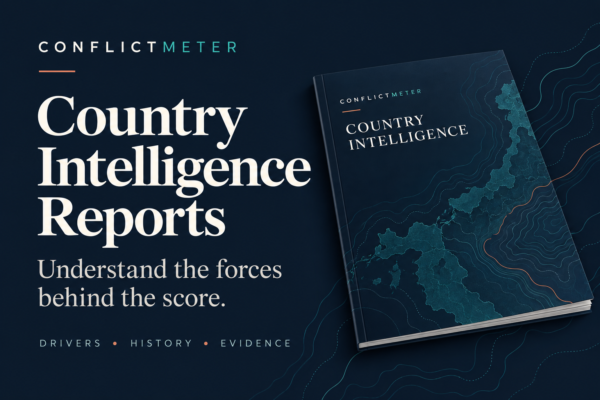
Go beyond the headline score
A headline reading raises a question. A Country Intelligence Report helps you investigate it: explore the structural drivers, historical comparisons, alternative interpretations and evidence towatch for your chosen country. Choose from 81 country-specific PDFs, at £49 each with no subscription.